- Faster disinflation could reduce future issuance by 18.9 million SOL across six years.
- SOL broke above the $107 level, but is now trading at $106 and $102.6 has emerged as immediate support.
- Governance approval was 67%, which was just slightly higher than the reported 66.67%.
Solana supply outlook shifted after governance approved faster disinflation for the network. The decision accelerates the path toward lower issuance while SOL consolidates following recent volatility.
Governance Vote Sets Faster Disinflation Path
Solana governance approved the Double Disinflation proposal with 67% support. The reported threshold stood near 66.67% for approval. Therefore, the measure passed by only 0.33 percentage points.
The vote represented approximately 433.49 million SOL in participating stake. Meanwhile, 25.16% voted against the proposal during governance. Another 7.84% of participating stake abstained from the decision.
The proposal raises annual disinflation from 15% to 30%. However, Solana’s terminal inflation target remains unchanged at 1.5%. Under the revised schedule, that target could arrive around 2029.
CryptosRus described the result as bullish because issuance should decline faster. The post also noted a Kraken-associated validator changed its position late. That shift reportedly helped the proposal cross the required approval threshold.
Lower Issuance Changes Future Supply
The approved schedule could reduce issuance by about 18.9 million SOL. That estimate covers the projected six-year period under the revised schedule. The reduction concerns future creation rather than existing circulating tokens.

CryptosRus valued the projected reduction at approximately $1.47 billion. That figure depends on the valuation assumption used in the discussion. Therefore, it represents avoided future issuance rather than removed market value.
Lower issuance would gradually reduce the flow of newly created SOL. If demand remains steady, markets would absorb less additional supply. At the same time, weaker issuance could reduce inflation-funded staking rewards.
The staking trade-off remains part of the proposal’s economic picture. Validators and delegators receive fewer newly issued tokens as inflation declines. Consequently, nominal staking yields could decrease under the faster schedule.
SOL Price Holds Between Key Technical Levels
SOL traded at $103.36, down 2.95% over the reported 24-hour period. Price opened near $106 before falling toward approximately $104. It then rebounded sharply, briefly moving above the $107 level.
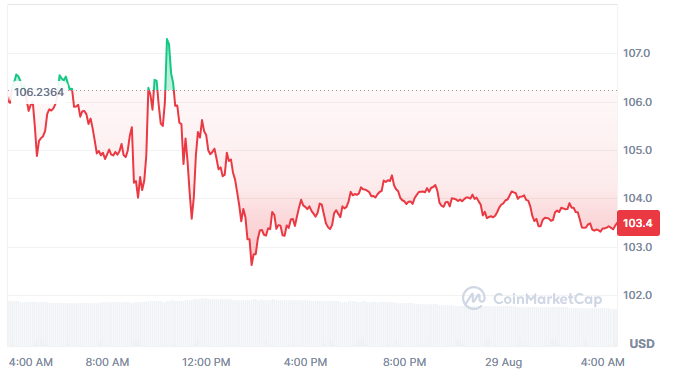
Sellers rejected that recovery, pushing SOL back toward roughly $102.6. Price subsequently recovered toward $104 and entered a narrower trading range. The $103 area then became the main short-term reference point.
A continuation of the move above $104-$105 would bolster the initial recovery framework. The $106-$107 area would be a place of interest if the movement occurs. Conversely, renewed weakness below $103 could expose the $102.6 session low.
Market data showed approximately $60.38 billion in SOL capitalization. Reported 24-hour volume stood near $5.09 billion, down 15.62%. Circulating supply reached roughly 584.16 million SOL, versus 633.07 million total supply.