
- XRP and Solana remain closely watched as liquidity rotation signals strengthen across large-cap infrastructure-focused blockchain networks.
- Shiba Inu continues reflecting retail sentiment trends that often influence volatility patterns during early altseason participation phases.
- Hedera and BNB remain relevant due to enterprise experimentation activity and exchange-ecosystem-driven participation signals.
Blockchain transaction volumes in Q1 2026 show concentrated activity across several major networks. Analysts report shifting liquidity patterns across high-throughput ecosystems.
Five networks, including SOL, BNB, TRX, POL, and APT, dominate reported activity.
Data suggests usage spikes align with broader market participation trends in crypto sectors.
However, risk exposure remains uneven across these networks during volatile trading cycles.
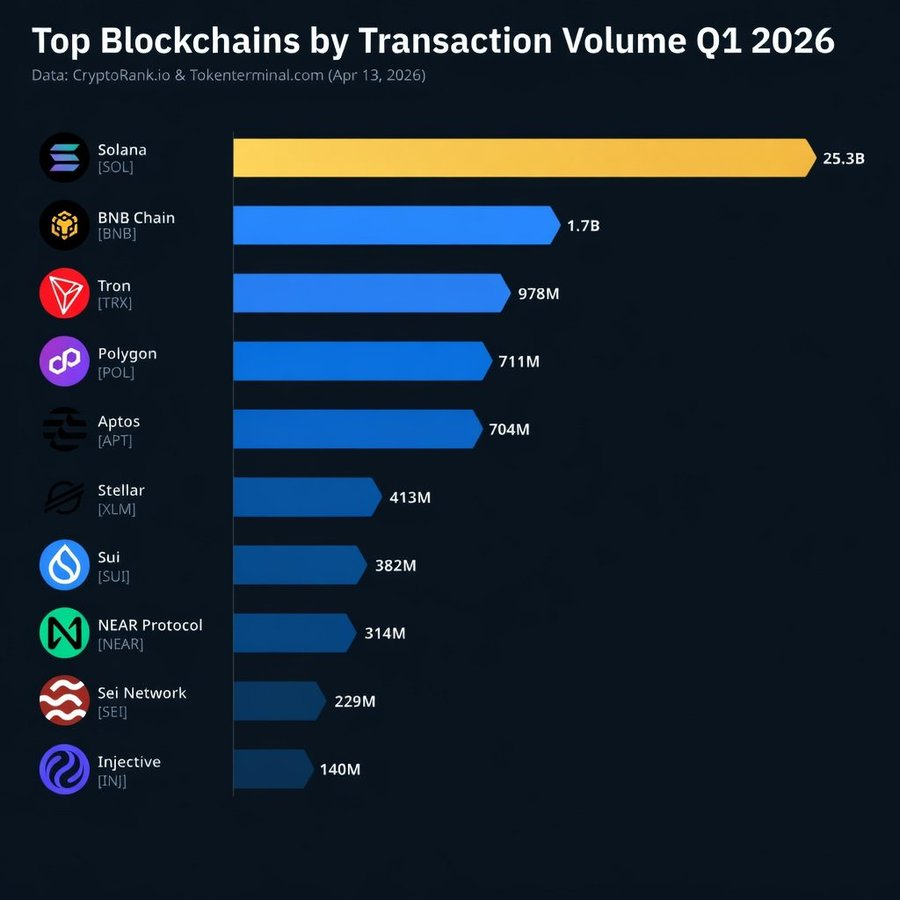
Source:(X)
Some networks rely heavily on exchange-linked flows, while others depend on scaling adoption and developer expansion cycles. This divergence highlights a shifting blockchain landscape shaped by performance competition and evolving user preferences. Overall, Q1 2026 data suggests strong engagement but also increasing variability in network sustainability indicators.

Solana (SOL): High-Speed Activity Network Under Pressure
The high-frequency trading and demand of the decentralized applications led to Solana recording outstanding transaction throughput in Q1 2026. However, there was a steady high network use throughout peak market periods demonstrating good user engagement behavior in the world market. The performance of the analysts was impressive in terms of scalability, even though congestions events were still evident when the spikes of high volume occurred. The transaction costs remained at a fairly low level, which sustained the further implementation by retail and institutional users. But usage volatility implies it is sensitive to the general market mood and speculative waves.
Binance Coin (BNB): Exchange-Linked Liquidity and Stable Demand Flow
BNB Chain continued to record impressive transaction volume, which is mostly backed by exchange-built applications and liquidity activities. The trends of activity were mostly stable, indicating stable user engagement in trading, staking services, and DeFi. The network demonstrated excellent resilience in the fluctuation of the markets, and there was little interference with the speed of processing transactions. The continued linkage of exchanges centrally affected the concentration of transactions in the ecosystem. However, the stability notwithstanding, analysts point out the risks of dependency, associated with the ecosystem activity based on exchange.
TRON (TRX): Transfer-Driven Network With Consistent Usage
TRON has exhibited high levels of consistency in its Q1 2026 transaction volumes which have mainly been influenced by the transfer of stablecoins. The turnover was high on a daily basis and patterns of predictable flows on wallet-to-wallet transactions were observed. The network demonstrated greater effectiveness in managing high throughput of transactions at a minimum cost. The concentration of usage was also heavily payment-oriented, as opposed to advanced smart contract usage. This arrangement provides stability, but restricts the diversity of application in the ecosystem.
Polygon (POL): Scaling Infrastructure With Expanding Developer Activity
The innovative volume of transactions was registered by Polygon, which is backed by the adoption of Layer 2 scaling on decentralized platforms. The use of the network rose gradually as developers moved over to applications that might be charged less and even respond faster. High-frequency decentralized applications realized profitable gains in their efficiency in terms of transaction activity. Upgrades on interoperability led to enhanced cross-chain functionality and integration into more ecosystems. Nevertheless, the threat of substitutes in terms of other scaling solutions is a structural challenge in the long-term.
Aptos (APT): Emerging High-Performance Chain With Rapid Growth
Aptos experienced tremendous transaction activity expansion that was caused by the growing involvement of developers and experimentation with the ecosystems. The network throughput also was increased since the infrastructure upgrades increased the speed and reliability of the execution. There was an upsurge in user activity in the form of gaming and DeFi applications, which are at the early adoption phase. The distribution of transactions is not even, which means that the ecosystem structure is evolving and immature. Sustainability in the long run is pegged on the retention of developers and the growth of the number of applications.
Comparative Outlook Across High-Activity Chains
The overall Q1 2026 statistics demonstrate a high-volume transaction in a few high-performance blockchains. All the networks exhibit distinct advantages, such as scalability and liquidity, as well as transfer efficiency and developer growth.Nonetheless, structural risks are associated with volatility, dependency and maturity of the ecosystems. Market observers are also keeping an eye on the trend of use as competition is growing in the Layer 1 and Layer 2 solutions.